
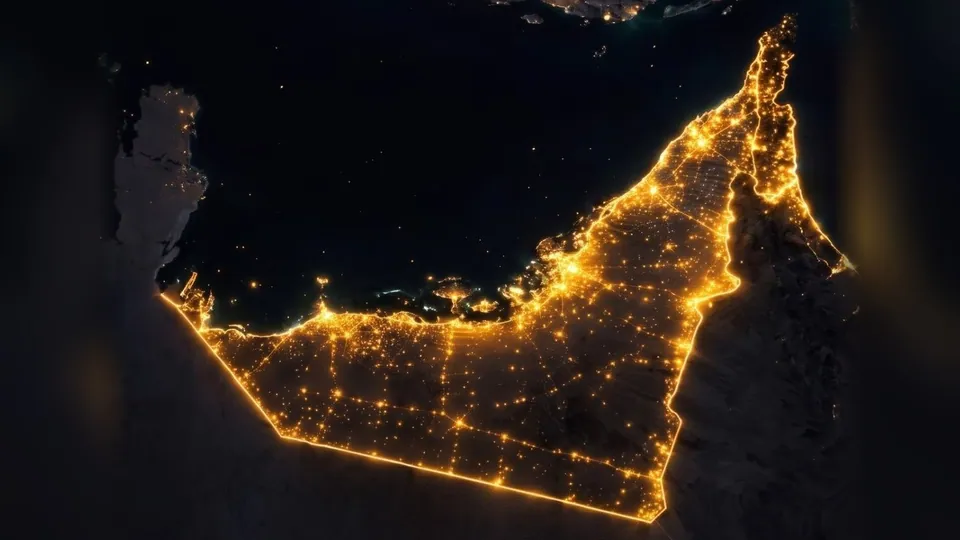
On 2 November 2026, Abu Dhabi signed four agreements with OpenAI, the company behind ChatGPT. The signing was witnessed by Sheikh Khaled bin Mohamed bin Zayed, Crown Prince of Abu Dhabi, after he met OpenAI chief executive Sam Altman (Abu Dhabi Media Office). The deals put AI to work across the government, the national oil company ADNOC and the state investor Mubadala, and they move Abu Dhabi closer to its goal of becoming the world's first fully AI-native government by 2027.
This is a technology story, but it matters to anyone buying property in the UAE. Below we explain, in plain language, what was signed, how "machine-readable government" works, and what it could and could not mean for Dubai real estate, as of 2 November 2026.
Abu Dhabi and OpenAI: the four agreements at a glance
| Agreement | Who signed | What it does |
|---|---|---|
| Machine-Readable Government (MRG) | Abu Dhabi Government and OpenAI, led by the Department of Government Enablement (DGE) | Turns government rules into a form AI can read, so AI can help officials with routine compliance checks for permits and certificates |
| Energy | ADNOC, G42 (through its subsidiary Inception42) and OpenAI | Makes ADNOC the first energy company to deploy OpenAI's frontier technology |
| Investment | Mubadala, Inception42 and OpenAI | Applies AI to investment analysis, finding opportunities and assessing risk |
| Five-year adoption deal | Inception42 and OpenAI | Supports AI adoption across government, business and education in the UAE |
Source: Abu Dhabi Media Office and Gulf News (WAM), 2 November 2026. No financial values were announced.
What is "machine-readable government"?
Every permit or certificate is checked against a set of rules. Today, officials read those rules and check each application by hand. Machine-Readable Government converts a defined set of policies and regulations into a format AI systems can read, so the AI can do the routine first check: does this application meet the rules or not?
- Humans still decide. According to the official announcement, every assessment is traceable to the rule it is based on, and government officials keep oversight and accountability for final decisions.
- It is already live. The first pilot is in production with the Abu Dhabi Agriculture and Food Safety Authority (ADAFSA), checking food imports.
- The data stays in the UAE. The AI runs on GPUs inside UAE data centres, using OpenAI's UAE inference residency (Abu Dhabi Media Office).
Sam Altman said Abu Dhabi and the UAE "are setting a bold, global standard for AI integration across both the public and private sectors."
Why the UAE, and why now?
The agreements are the latest step in a plan the UAE has followed for nearly a decade:
- 2017: the UAE launched a national AI strategy and appointed the world's first minister for artificial intelligence.
- January 2025: Abu Dhabi's Government Digital Strategy 2025–2027 set aside AED 13 billion to automate government processes and adopt sovereign cloud computing. It aims to add more than AED 24 billion to Abu Dhabi's economy and create more than 5,000 jobs by 2027 (The National).
- May 2025: the UAE became the first partner in OpenAI's "OpenAI for Countries" programme, with Stargate UAE, a 1-gigawatt AI computing cluster in Abu Dhabi built by G42 and operated by OpenAI and Oracle (OpenAI).
- October 2026: an AI training programme with OpenAI and Microsoft aims to train 20,000 government employees and members of the public (The National).

What it means for Dubai real estate
The agreements were signed in Abu Dhabi and do not change any property law in Dubai. But they point in a direction that matters to buyers across the UAE.
1. Faster, more digital property transactions
Dubai is moving the same way. In September 2026 the Dubai Land Department (DLD) launched Initial Registration, an AI-powered platform for developers. It reads Emirates IDs, passports and sales contracts, fills in application fields automatically, and approves registrations that meet the business rules on submission (DLD, 3 September 2026). DLD links it to a national target of running 50% of government services and operations on agentic AI within two years. For overseas buyers, the practical effect is less paperwork and fewer delays when buying from abroad. DLD has not published a figure for how much time it saves.
2. Demand from people who move here for work
The AI build-out brings jobs in technology, energy and finance, and people who move for work need somewhere to live. Industry figures quoted by Gulf News (November 2025) describe a new phase of demand from skilled professionals relocating to the UAE, and note that around 80% of expatriates in Dubai rent. No official data yet shows how much of Dubai's demand comes from AI-related jobs, so treat this as a direction rather than a number.
3. A long-term confidence signal
Investors look for stability and a clear plan. Agreements involving a sovereign wealth fund, the national oil company and the government itself, with the technology running inside the UAE, show that the country is committing to a long-term AI economy. That supports the case for the UAE as a place to live, work and invest. It is a signal, not a guarantee: property prices depend on supply, interest rates and many other factors.
What it does not mean
- It does not set property prices or rents, and there is no direct link between these agreements and any area's values.
- It is not a reason on its own to buy. Choose a property for its location, quality, developer track record and price.
If you are weighing Dubai as a base for your family or your investment, our Dubai investment guide covers buying costs, visas and renting out, and our Golden Visa guide explains residency through property. To talk through a specific purchase, start your property brief.
What we don't know yet
- The value of the agreements: no financial terms were published.
- Which government services MRG will cover after the food import pilot, and when.
- Whether Dubai government bodies will use the same system. The agreements announced are with Abu Dhabi entities.
We will update this article as details are published.
Abu Dhabi's OpenAI deals: quick answers
What did Abu Dhabi sign with OpenAI?
Four agreements on 2 November 2026: the Machine-Readable Government initiative, an ADNOC deployment, an investment AI agreement with Mubadala, and a five-year AI adoption agreement between Inception42 and OpenAI.
Will AI make government decisions in Abu Dhabi?
No. AI helps with routine compliance checks, and officials keep oversight and accountability for final decisions.
What is an AI-native government?
A government that builds AI into its systems and services from the start. Abu Dhabi aims to be the first fully AI-native government across all digital services by 2027.
Does this affect Dubai property prices?
Not directly. It supports the long-term case for the UAE as a place to live and work, and Dubai is already using AI to speed up property registration, but prices depend on supply, demand and financing.
Sources
- Abu Dhabi Media Office: Khaled bin Mohamed bin Zayed meets Sam Altman and witnesses signing of agreements with OpenAI, 2 November 2026
- The National: Abu Dhabi agrees OpenAI deals to transform government services and education, 2 November 2026
- Gulf News: Khaled bin Mohamed meets OpenAI CEO Sam Altman, 2 November 2026
- OpenAI: Introducing Stargate UAE, 22 May 2025
- Khaleej Times: Abu Dhabi launches Dh13 billion strategy to become world's first fully AI-native government by 2027
- Dubai Land Department: Initial Registration launch, 3 September 2026
- Gulf News: Dubai real estate demand climbs as global talent shifts from US to UAE, 24 November 2025
This article is for general information only and is not financial or investment advice. Details are from the sources listed as of 2 November 2026 and may change.