
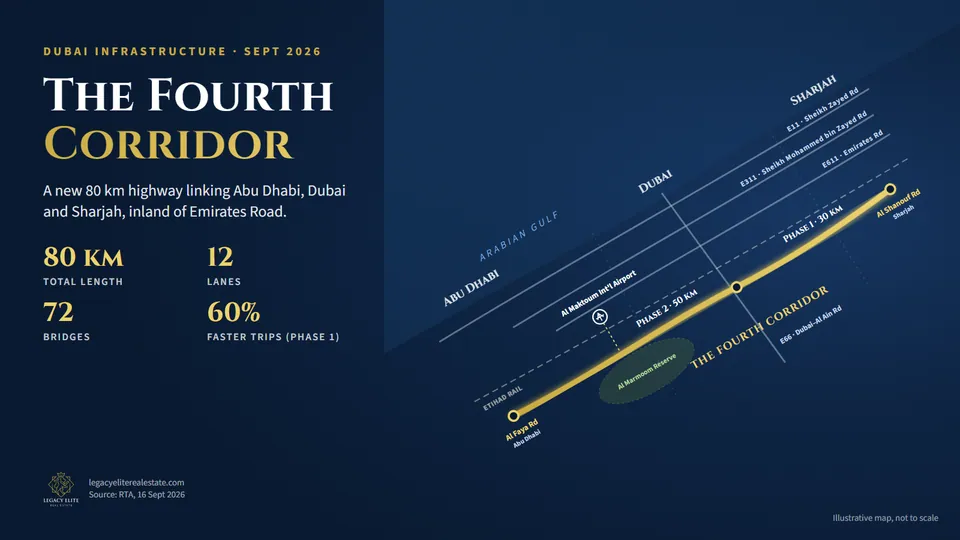
Dubai has approved the New Fourth Corridor, an 80km highway that will run inland from Abu Dhabi to Sharjah, well beyond Emirates Road. It is the first new strategic road link between the emirates in years, and it is designed to take pressure off the three corridors that carry most of today's traffic. Here is what has been announced, what the road will connect, and what it could mean for Dubai property.
What is Dubai's Fourth Corridor?
On 16 September 2026, His Highness Sheikh Hamdan bin Mohammed bin Rashid Al Maktoum, Crown Prince of Dubai, approved the project, which will be delivered by Dubai's Roads and Transport Authority (RTA). It is called the Fourth Corridor because it becomes the fourth strategic road linking the UAE's emirates, after:
- E11: Sheikh Zayed Road / Al Ittihad Road, along the coast
- E311: Sheikh Mohammed bin Zayed Road
- E611: Emirates Road
The new road will stretch about 80km from Al Faya Road in Abu Dhabi to Al Shanouf Road in Sharjah, passing through Dubai further inland than any of the existing corridors. In total the project includes 72 bridges, 17 tunnels and 45 stormwater drainage culverts.
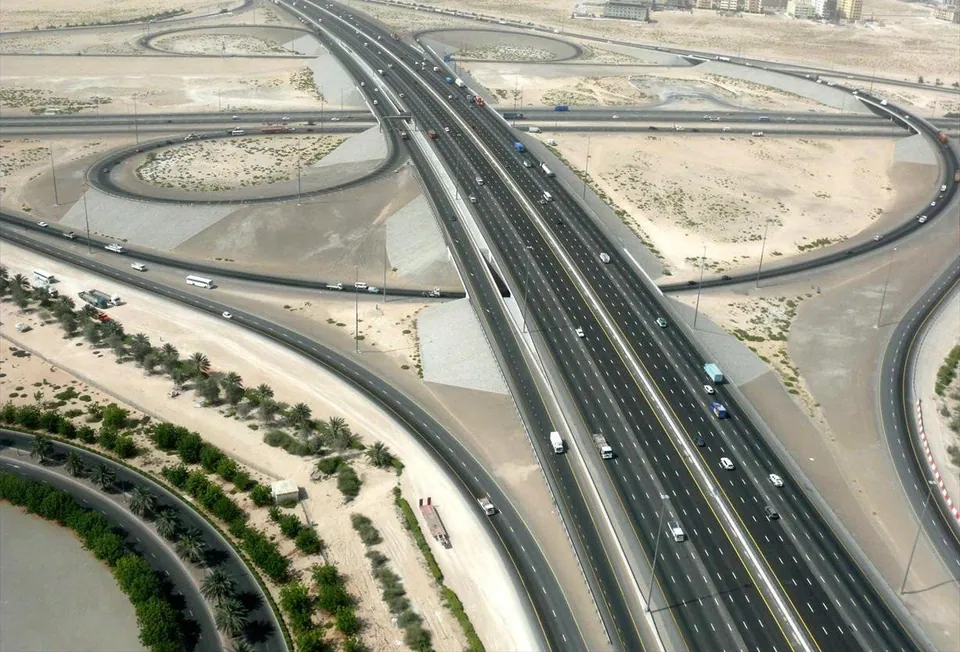
The route and the two phases
The corridor will be built in two phases, split at Dubai–Al Ain Road (E66):
| Phase 1 | Phase 2 | |
|---|---|---|
| Route | Al Shanouf Road (Sharjah) to Dubai–Al Ain Road | Dubai–Al Ain Road to Al Faya Road (Abu Dhabi) |
| Length | About 30km | About 50km |
| Cost | About AED 3.5 billion (US$953 million) | Not yet announced |
| Lanes | 12 (both directions) | 12 (both directions) |
| Capacity | Up to 24,000 vehicles per hour | Up to 24,000 vehicles per hour |
| Journey time | 35 min to 14 min (60% faster) | 50 min to 24 min (52% faster) |
| People served | About 600,000 | About 3.1 million |
| Main works | 55 lane-km of roads, 2.5km of tunnels, 21km of bridges and ramps | 190 lane-km of roads, 3.5km of tunnels, 157km of bridges and ramps |
Phase 1 also includes upgrades to four major intersections and widening Dubai–Al Ain Road between Emirates Road and Lehbab Road from three to four lanes in each direction.
How much time will it save?
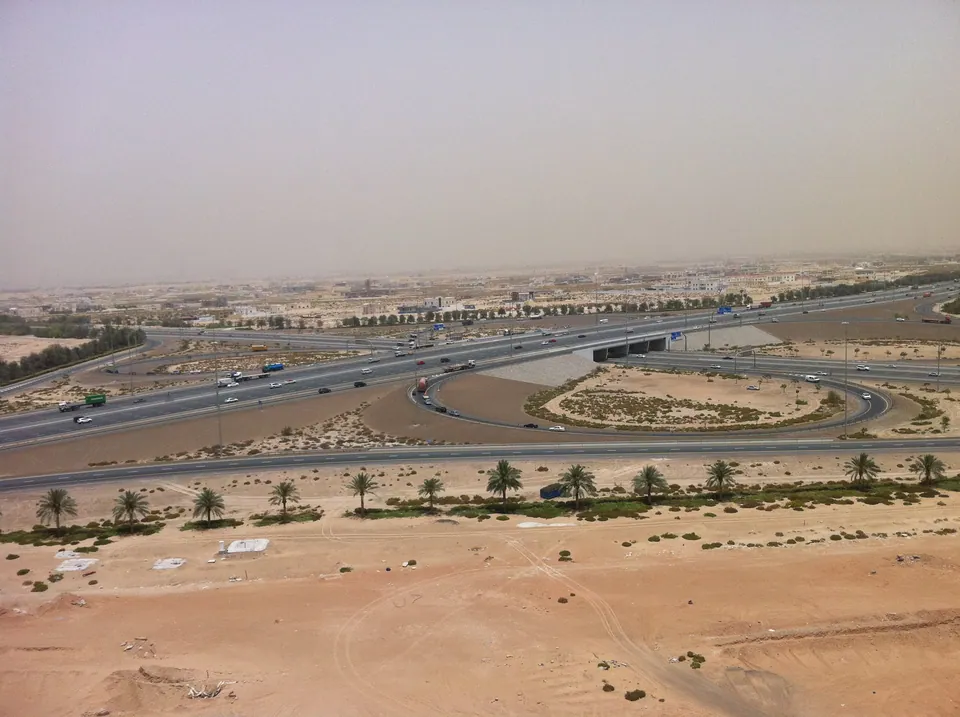
According to the RTA, Phase 1 will cut the journey from Al Shanouf Road in Sharjah to Dubai–Al Ain Road from about 35 minutes to 14 minutes, and Phase 2 will cut the trip from Dubai–Al Ain Road to Abu Dhabi from about 50 minutes to 24 minutes. With 12 lanes and capacity for up to 24,000 vehicles an hour, the road is also designed to carry logistics traffic, which should ease congestion on Emirates Road and Sheikh Mohammed bin Zayed Road for everyday commuters.
These are projected times for when each section opens. Until then, today's journey times on the existing corridors still apply.
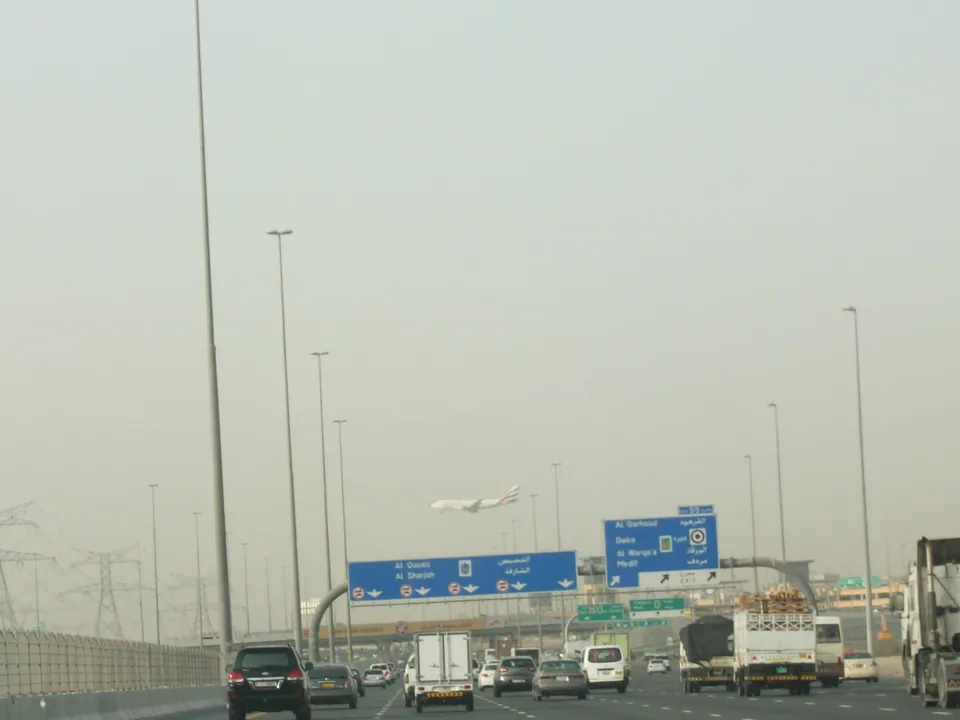
What the new corridor connects
The route will pass or link several of the areas that matter most for Dubai's next stage of growth:
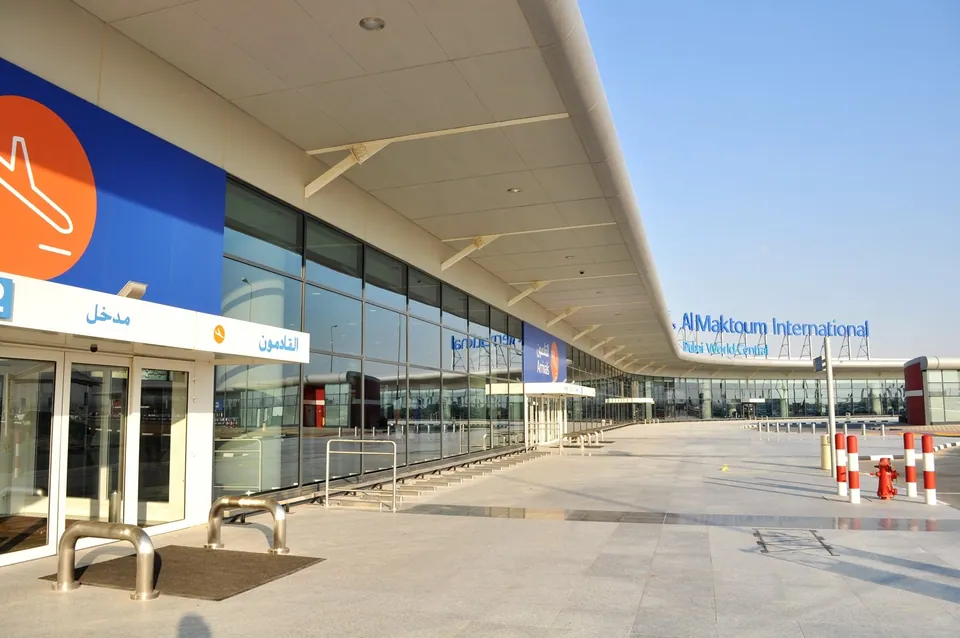
- Al Maktoum International Airport in Dubai South, which is being expanded into one of the world's largest airports (see our Why Dubai guide to the megaprojects).
- The Etihad Rail route, the UAE's national railway, which is launching passenger services.
- Al Marmoom and Al Wohoosh desert conservation reserves, Dubai's largest protected desert areas.
- Existing and future residential and development areas between Dubai's established suburbs and the desert.
Why it matters for property investors
New roads and rail lines have repeatedly shaped where Dubai grows. The Fourth Corridor is an infrastructure announcement, not a property launch, but it is worth understanding. Here is how we see it:
- Dubai's growth keeps moving inland. The city's newest airport, rail line and road corridor are all being built away from the coast. That points to continued demand in communities around Dubai South and the inland districts the road will serve.
- Shorter commutes widen the market. Faster links between Sharjah, Dubai and Abu Dhabi make more communities practical for people who work across emirates, which supports rental demand in well-connected areas.
- Logistics means jobs. A road designed for freight, next to the Etihad Rail route and Al Maktoum Airport, supports employment in the south of the city, and people generally want to live near where they work.
- Buy on fundamentals, not announcements. No completion date has been published yet, and major roads take years to build. Choose a property that makes sense today, and treat future infrastructure as an upside rather than the whole investment case.
If you'd like to know how projects on our list fit in, browse all our properties or speak to our team for an honest view.
When will the Fourth Corridor open?
As of 24 September 2026, the RTA has approved the project and published its scope and cost, but has not announced a construction timeline or opening date. Phase 1, the Sharjah to Dubai–Al Ain Road section, is the first to be delivered. We'll update this article when a timeline is announced.
Fourth Corridor: quick answers
Where does the Fourth Corridor start and end?
It runs about 80km from Al Faya Road in Abu Dhabi to Al Shanouf Road in Sharjah, passing through Dubai inland of Emirates Road.
How much will it cost?
Phase 1 is budgeted at about AED 3.5 billion (US$953 million). The cost of Phase 2 has not been announced.
How many lanes will it have?
12 lanes across both directions, with capacity for up to 24,000 vehicles per hour.
Which roads is it parallel to?
It runs in the same direction as Sheikh Zayed Road (E11), Sheikh Mohammed bin Zayed Road (E311) and Emirates Road (E611), but further inland.
Sources
- Gulf News: Dubai's New Fourth Corridor, 80km road linking Abu Dhabi, Dubai and Sharjah, September 2026
- Khaleej Times: Dubai's 80km fourth highway explained, 17 September 2026
- Sharjah24 (WAM): Hamdan bin Mohammed approves New Fourth Corridor project, 16 September 2026
- Time Out Dubai: Sheikh Hamdan approves New Fourth Corridor
- Construction Business News Middle East: Dubai approves AED 3.5bn Fourth Corridor
- Middle East Construction News: Sheikh Hamdan bin Mohammed approves New Fourth Corridor project
Route map: Legacy Elite Real Estate, illustrative and not to scale. This article is for general information only and is not financial or investment advice. Figures are from the sources listed and may change as the project progresses.